AI for the People: The Ongoing Journey of Sogni
A look at the amazing story of Sogni, from conception to one of the hottest AI platforms on the planet, with Sogni CEO Mauvis Ledford
11 minute read
Ready or not, the AI revolution is upon us.
Exactly how far this revolution will reach, and exactly how it will impact our lives remains to be seen, but there’s no question that artificial intelligence has already begun to shift the shape of our world.
Nowhere is this shift more apparent today, more emotionally charged, or potentially more culturally significant than it is in the realm of art. As AI’s tendrils began to extend into this sacred space — once the exclusive purview of the human mind — fascinating questions about what this new technology meant for the fundamental nature of creativity itself began to emerge.
To some, this pivotal moment represented the beginning of a global artistic decline. To others, like Mauvis Ledford — CEO of emerging creative AI platform Sogni, it represented something else: the beginning of a new and exciting technology-driven artistic renaissance.
“I believe that AI gives artists a creative superpower: the ability to explore thousands of ideas instantly. It doesn’t replace the artist; it amplifies their vision. Just like photography or synthesizers, it expands the boundaries of expression. The intent still comes from the human, and AI just accelerates the path from imagination to final work.” — Mauvis Ledford
Regardless of which side of this philosophical divide one fell into, however, one undeniable fact was becoming clear: the conversation around art and creativity was changing forever. And, as the heady philosophical soup of this debate first began to simmer, the story of Sogni AI began…
The Story of Sogni #
Originally conceived in 2022 by co-founders Mauvis Ledford (now CEO), Mark Ledford (now CTO), and Alejandro Ramos (now CPO), Sogni’s journey into being has been a long and winding one. Prior to Sogni’s conception, its founding team worked together at CoinMarketCap, where early conversations about the emergence of AI-powered creative tools, open-source models, and the limitations of available hardware and platforms planted the seeds of what Sogni would one day become.
At the time, AI’s capabilities were expanding rapidly. Its accessibility… not so much. Open source models were becoming more powerful by the day, but remained difficult to use (not to mention costly). While local generation was indeed possible, it was painfully slow. Centralized AI platforms, meanwhile, were beginning to consolidate into walled gardens where speed, compute, and ownership were being gradually wrested from the hands of artists.
For Sogni’s founders — Mauvis Ledford, his brother Mark, and Alejandro Ramos, the problem was clear. When Ramos presented a solution in the form of Sogni V1 — a native Mac app that consolidated 100-plus open-source models into a single, clean user interface with no command lines and no technical barriers, the solution began to become clear as well.
With Ramos’ tool as the framework, the Sogni founding team set out to expand on his simple idea and make it workable at scale. Sogni Supernet — a Graphics Processing Unit (GPU) network leveraging the processing power of multiple user computers — provided the muscle and speed required to compete with other products on the market, and Sogni AI was born.
Its mission: to decentralize, democratize, and make accessible generative AI forever.
Honing the Vision #
The case for building Sogni wasn’t just a product opportunity. It was a direct response to an emerging set of four problems that were, at the time, quietly re-shaping the digital creative world.
1. The centralization of creative AI #
The world’s most recognized AI platforms were specifically designed to be centralized walled gardens. Within them, platforms dictate what artists can create, filtering artistic expression through arbitrary moderation systems and snatching up user data at scale along the way.
2. Accessibility #
While AI platform subscription costs may be no big deal to some, globally they represent a significant barrier for many. Open-source models, while widely available, often require a level of technical fluency, as well as hardware, that many artists simply don’t have.
3. Economic imbalance #
Centralized platforms profit from user creativity without meaningfully sharing that value with users. Creators supply the imagination, the prompts, and the attention that help AI platforms grow, yet platform owners absorb the lion’s share of the revenue and data their work generates.
4. The Privacy/Ownership Problem #
As centralized platforms have grown, the creative process has become just another stream of data to be harvested. Inside these closed systems, artists lose control of their work the second it’s generated. Creators have no meaningful way to prove origin or maintain authorship over what they produce.
“Most platforms lock you into subscriptions, restrictions, and closed models. Sogni is a decentralized, privacy-first Supernet that lets anyone generate at massive scale — up to 512 images at once — using the latest cutting-edge open-source models, at a fraction of the usual cost. No monthly fees, no vendor lock-in, no training on your private data.
Artists get total freedom, GPU owners earn real income, and model creators receive ongoing royalties. It’s the only Creative AI network where the community powers the tools and shares the value. Everyone wins except the monolithic tech companies.” — Mauvis Ledford
With a working platform that addressed these four important problems in place, all that remained was to bring Sogni to market. But, as any tech founder can tell you, bringing a new product to market is a more complex — and expensive — proposition than it sounds.
So, when TZ APAC — a Tezos ecosystem development team based in Southeast Asia — put out the call for applications for the 2025 cohort of its Fortify Labs Web 3.0 startup studio, Mauvis and the Sogni team made their move…
A Meeting of the Minds: Sogni Enters the Tezos Ecosystem #

Entering its third year on the global Web 3.0 startup scene, Fortify Labs has emerged as the preeminent startup studio program in the Southeast Asian region. Backed by the Tezos Foundation — with a rich history of supporting artists and projects in the global blockchain art scene of its own — Fortify Labs is a whole lot more than just another incubator/accelerator program.
As a successful applicant, Sogni was part of a very small cohort (a maximum of 7 projects per year) provided with funding and significant custom-tailored support as it moved toward mainnet launch and its first token generation event (TGE).
The decision to realize the Sogni team’s vision in the Tezos ecosystem and build out its project on EVM ecosystem bridge Etherlink was not one anyone at Sogni took lightly. But, after peeking under the hood at what Etherlink and the Fortify Labs team had to offer, Mauvis and the Sogni founding team were sold…
“First, it was the people. The TZ APAC team are some of the friendliest, most inquisitive, and supportive people I’ve ever met. Then it was the tech: Etherlink is what is advertised, fast, fair, and nearly free. Our EVM contracts deployed here with zero issues or rewrites.
We needed a chain that could handle high-volume micropayments, NFT minting, and token-bound model wallets without high fees. Tezos/Etherlink gives us speed, stability, and a long history of supporting digital art. It’s eco-friendly, creator-centric, and deeply aligned with our mission to give artists ownership and provenance. And Etherlink’s EVM compatibility lets us bridge seamlessly with other EVM networks.” — Mauvis Ledford
Working hand-in-hand with the Fortify Labs team, Mauvis, Mark, and Alejandro set forth to unveil the fruits of their collective vision to the world…
“The on-the-ground support has been epic, from helping us throw events, to thinking through and deploying marketing campaigns and contests, to feature validation. Fortify Labs has also helped us sharpen our on-chain strategy and stress-test key assumptions with people who deeply understand creator ecosystems. Fortify Labs gave us credibility and visibility at exactly the right moment — just as we prepared for mainnet and TGE.” — Mauvis Ledford
Sogni Breaks out #

With seed funding, a working product, and substantial support in place, Sogni AI completed its mainnet launch on July 2, 2025. In the short months since, it has gone on to onboard more than 84,000 users who have generated over 148 million (as of this writing) images on its platform. Its Supernet has expanded to over 800 GPU nodes, enabling lightning-fast rendering speeds that keep it apace with the biggest brands in the generative AI arena.
Sogni has successfully launched its first token generation event, introduced new features across its Studio, Pocket, and Web offerings, and built one of the most engaged communities of artists and users in the space across multiple platforms, including:
“The response has been phenomenal: tens of thousands of artists, millions of images generated, and a fast-growing AI community on X and Discord. People love the speed, the freedom, and the fact that nothing is locked behind corporate gates. GPU owners (normal people like you and me) are thrilled because they can earn passive income when they’re not using their machines. And artists tell us they can reimagine art in new ways they’ve never considered. For example, a student made organic building designs based on inputting crumpled up pieces of paper and ideating on it with AI.” — Mauvis Ledford
Sogni’s GPU network, as Ledford mentions above, makes use of the shared idle computing power of users’ computers. Users provide the computing power to make Sogni run, and in return they receive tokenized rewards — up to $350 USD monthly.
It all adds up to one of the most promising grassroots AI art projects in existence. But to hear Mauvis Ledford and the Sogni team tell it, their ambitions for Sogni extend much further still…
What comes next? #

Ask Mauvis Ledford what Sogni has in store for 2026 and beyond, and he won’t talk about incremental updates or additional features. Instead, he’ll talk about something much more ambitious: building the default decentralized creative AI layer for the internet writ large.
“2026 is when Sogni becomes the default decentralized Creative AI layer. We’re launching video generation, custom LoRA training, Windows and Android support, on-chain artist profiles, and full NFT minting. The goal is simple: open-source AI that’s as powerful as Big Tech, but owned and powered by the community. The future of creative infrastructure won’t be centralized — it will be built by the people who use it.” — Mauvis Ledford
A platform not just for image generation, but a full suite of tools enabling the full spectrum of AI-assisted creative expression. Video, animation, character design, world building, storytelling, and more.
A network anyone can contribute to, anyone can build upon, and anyone can use.
Sogni truly is AI for the people.
What does this mean for me? #
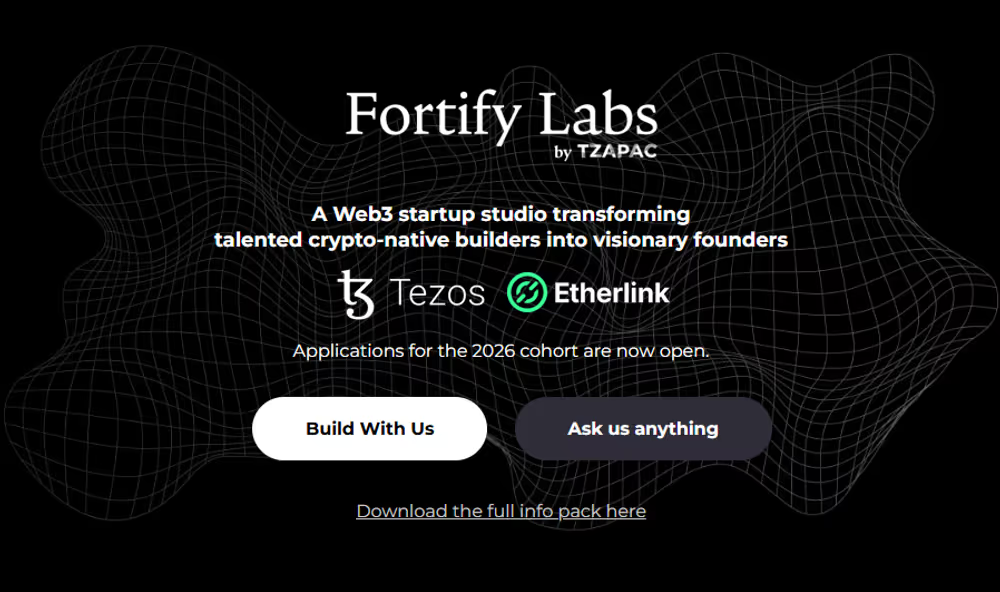
Sogni stands, today — just a few short months since its mainnet launch — as an incredible success story, not only for its founders and users, but also for the Fortify Labs startup studio and the team behind it: TZ APAC.
TZ APAC has recently put out the call for applications for its 2026 cohort.
If you’re a builder working on a project in
- AI
- DePIN
- Decentralized creative tools
- Digital identity
- Open-source infrastructure
- Gaming
- Or any consumer-facing Web 3.0 product with real user actions
The Fortify Labs program is an opportunity you might want to check out. If you’re interested in getting involved:
Start by reviewing the Fortify Labs application form here, and fill it out when you’re ready.
Stay updated on program news by following the TZ APAC X account and joining the TZ APAC Telegram group.
The official Fortify Labs website can be found here.