Announcing Ganesha: A 7th Upgrade Proposal for Etherlink Mainnet
Etherlink 7.0 introduces the Michelson interface and Native Atomic Composability (NAC), preparing the network for Tezos X. Governance vote starts 03/08/26.
8 minute read
Today we’re announcing Etherlink 7.0, our latest major upgrade proposal for the Etherlink kernel. If supported by Tezos L1 bakers via a successful governance vote, Etherlink 7.0 will bring the most significant expansion of Etherlink’s scope since launch, focused on composability. It introduces:
- The Michelson interface, which brings Michelson smart contracts and the Tezos account system to Etherlink as first class citizens.
- Native atomic composability (NAC) between the two interfaces, so that Tezos accounts can own and use Etherlink’s native assets, and EVM accounts can reach Michelson contracts — in both directions, atomically.
Together with Etherlink 7.0, the Octez EVM node now exposes** a subset of the**** octez-node RPCs**, so that existing Tezos indexers, wallets, and dApps can interact with Etherlink as if it were another Tezos network.
Etherlink 7.0 establishes the necessary infrastructure for** Tezos X**, a trustless execution environment enshrined in the Tezos protocol and secured by Tezos Layer 1. This architecture provides a unified ledger accessible through both the EVM interface and Michelson interface, linked by native atomic composability. By introducing these components, this proposal prepares the network for the full Tezos X rollout scheduled for later this year.
We intend to publish a proposal to activate Etherlink 7.0 on Etherlink Mainnet using the slow track of the governance process on August 3, 2026.
For a comprehensive list of changes compared to the kernel currently deployed on Mainnet and links to the code changes, refer to the kernel’s changelog. Below are the most important improvements and some other notes about the upgrade.
Two interfaces, one chain
Until now, Etherlink has been the Tezos’ EVM-compatible execution layer: compatibility with the Ethereum ecosystem through EVM bytecode support and an implementation of the Ethereum JSON-RPC API.
The Etherlink 7.0 proposal introduces the concept of interfaces, and with it, a name for what already existed: the EVM interface. Etherlink 7.0 adds a second interface. The Michelson interface brings Tezos accounts, Michelson contracts, and Tezos operations to Etherlink natively rather than bridged. Both interfaces operate over the same ledger, and, thanks to native atomic composability, accounts on either side can transact with applications on the other.
Introduction of this new interface is a major milestone on the Tezos X roadmap, laying the ground for what will one day become the Tezos X.The bulk of the engineering work behind this proposal went into the Michelson interface and the composability layer that connects the two, though the EVM runtime picked up improvements of its own along the way.
The Michelson interface
The Michelson interface brings the Tezos smart-contract platform to Etherlink directly. Michelson contracts can be originated and executed on Etherlink, and Tezos accounts are now first-class citizens of Etherlink’s ledger — tz1, tz2, and tz3 implicit accounts as well as Michelson smart contracts. The Michelson Interface is also compatible with Ligo and SmartPy. Two current limitations are worth noting for builders: tz4 implicit accounts are not yet supported, and the Michelson interpreter in this release does not yet support BLS, Global Constant, Sapling, Tickets, Timelock and the operation allowing someone to preallocate storage for a smart contract.
The Etherlink blockchain can also process a subset of Tezos operations. The scope is deliberate, and it is worth being precise about what falls outside it:
- Smart rollup operations are not supported, and no support is planned.
- Consensus, staking, delegation, and DAL operations are out of scope for Etherlink.
- Governance operations are not supported. The governance of Etherlink does not change with this proposal and remains implemented through trusted smart contracts deployed on Tezos L1 Mainnet.
- Increasing the paid storage of smart contracts is not yet implemented.
Finally, Etherlink nodes now expose a subset of the octez-node RPCs. This is the part most likely to matter on day one for the existing Tezos ecosystem: indexers, wallets, and dApps built against Tezos L1 can interact with Etherlink’s Michelson interface as though it were another Tezos network, without being rewritten.
Native Atomic Composability
Native Atomic Composability — NAC for short — is the ability for an account belonging to any interface Etherlink supports to interact with any dApp hosted on Etherlink, without breaking the pre-existing invariants of either interface. In this release, that means any Tezos account can own Etherlink native assets hosted in the EVM interface, and vice versa.
It works through a gateway on each side:
- The EVM interface gains a new precompile contract at
0xfF00000000000000000000000000000000000007, which acts as a gateway to the Michelson interface. EOAs and EVM smart contracts that call this precompile are assigned a KT1 address on the Michelson runtime. - The Michelson interface gains an L2-specific native contract at
KT18oDJJKXMKhfE1bSuAPGp92pYcwVDiqsPw, which acts as a gateway to the EVM interface. Implicit accounts and smart contracts that generate calls to this native contract are assigned an Ethereum address on the EVM interface, associated with an account that correctly implements EIP-1271.
In both directions, tez transferred to an address assigned to an account living behind the other interface is automatically forwarded through the corresponding gateway.
The two ecosystems can now build on each other rather than sitting side by side in silos. We expect to see Michelson-native applications deployed on Etherlink to tap into the liquidity already there, and EVM contracts partially rewritten in Michelson so that their most sensitive components become easier to formally verify — among other use cases we are yet to discover.
Exploring NAC on Previewnet
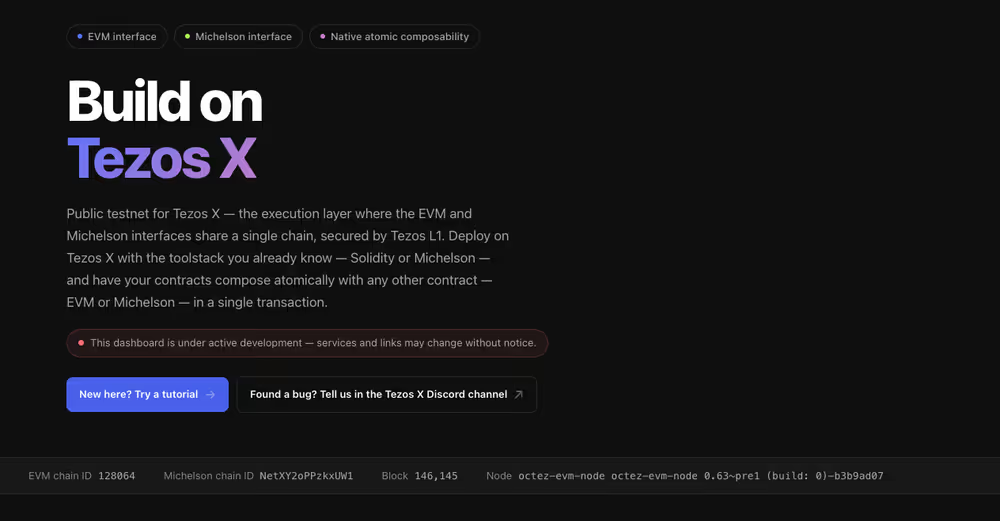
The infrastructure for the Michelson interface and NAC has been live on the Tezos X Previewnet since May 2026. Developers can experiment with these features today via the cross-interface counter demo.
In this demonstration, the application state is maintained within Michelson contract storage, while a Solidity contract routes increment() and decrement() invocations to it through the gateway precompile. This allows a standard MetaMask transaction to mutate Michelson storage directly. This atomicity is a key feature: if a Michelson entrypoint fails, for example, by calling decrement when the counter is at zero, the entire EVM transaction reverts. No partial states are committed, no events are emitted, and indexers like Blockscout report a failed transaction. Because both interfaces commit or fail together, there is no need for bridge trust or complex state reconciliation.
A comprehensive walkthrough is available to guide you through building both contracts, from SmartPy origination to deployment via Remix. Complete technical documentation for both interfaces can be found at x.tezos.com/docs.
Improvements to the EVM interface
Two fixes bring Etherlink’s EVM execution closer to standard semantics:
- Tez deposits now trigger script execution. Deposits targeting smart contracts, and deposits targeting EOAs with EIP-7702 delegation enabled, now execute the associated script. Previously the balance was simply increased, which does not match EVM semantics.
- Gas is properly refunded when a precompile contract reverts. It was previously consumed in full.
Next steps & How to Participate
Etherlink 7.0 requires the Octez EVM node version 0.64. Node operators and providers running an older version will need to upgrade their infrastructure, or face regressions and feature breakage. If you are already running a node against Mainnet, stop the node, upgrade it, and start it again as described in the EVM node documentation.
A node that runs through the activation will not serve the Michelson interface’s octez-node-compatible RPCs until it is restarted. If you intend to expose those RPCs, plan a restart after activation as well as the upgrade before it.
Once the upgrade is live on Testnet, the governance process will begin. Make sure your voting key is ready so you can take part in the upcoming proposal vote.
Proposal Voting 🗓️ #
We plan to announce and release the upgrade so that it can be subject to governance along this timeline:
- Proposal period vote: slow governance period 40, from L1 level #14,328,289, expected to start on August 2 2026, 2:36PM CEST…
- Promotion period vote: slow governance period 41, from L1 level #14,395,489, expected to start on August 7 2026, 6:36AM CEST.
The ETA of these blocks might be affected by network delays and may drift slightly. For up-to-date information, see the governance page.