Becoming a Tezos Baker in 2026
Costs, hardware, and what running one looks like.
7 minute read

Tezos baking has changed quite a bit over the past few years. The stake requirement has come down, the available tools have improved, and a small home server can handle the whole setup. And with the current state of the market, the dollar entry price is also close to the lowest it has ever been.
So, in this article, we are going to look at what it takes to become a Tezos baker in 2026. How much tez do you need? What kind of machine should you buy? What does the DAL add to the setup? And once everything is running, how much work is involved? Let’s get into it.
Tez Requirements and Rewards #

To bake entirely with your own funds, you need 6,000 tez of baking power. At the time of writing, that comes to roughly $1,300. The important thing to understand is that this tez is not spent. It stays in your account while being staked, and you continue to own it.
With that amount, you can operate as a private baker and receive your baking and attestation rights directly. The current staking rewards are at ~7.79% APY, although Adaptive Issuance adjusts the rate over time depending on how much tez is staked across the network. Now, the full 6,000 tez does not have to come from you.
A baker needs at least 600 tez of its own stake, while other holders can provide the remaining baking power. To do that, they can either stake directly with your baker while keeping custody of their funds, or delegate their tez to you. Keep in mind, though, that delegated tez counts as one-third of its balance, so for example, if they delegate 3,000 tez, that would add 1,000 tez of baking power.
Personally, I think starting with your own 6,000 tez is the simplest way to begin as a private baker because it removes the need to find external stakers or delegators. But if you don’t have the amount needed, it’s good to know that there is an alternative way. Regardless of the way you go about it, once you register, your first baking and attestation rights should appear on TzKT within two to three days.
A Small Machine Can Handle It #
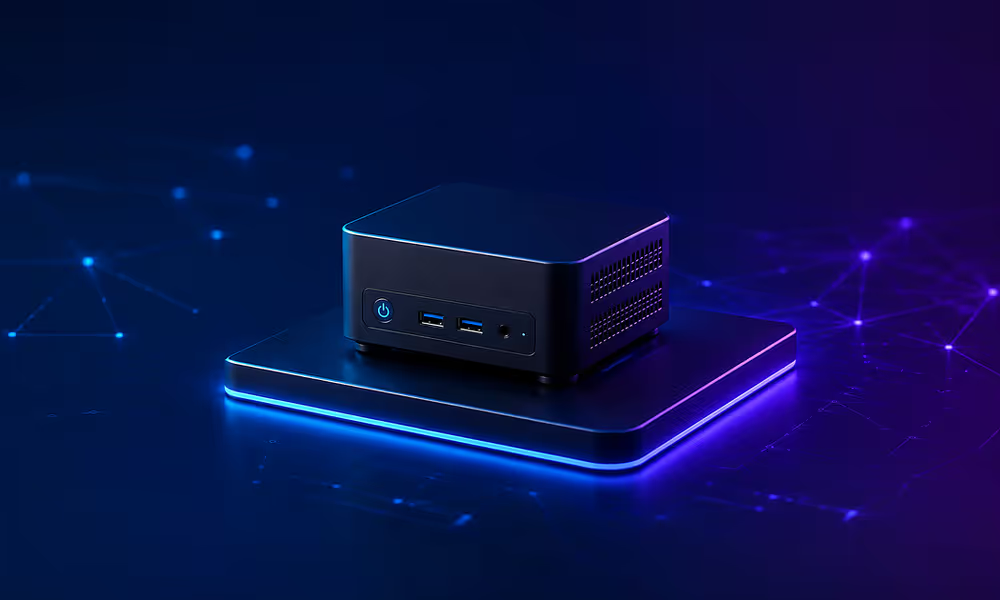
According to the Octez documentation, the minimum requirements for an Octez node and baker are three CPU cores, 8 GB of RAM plus 8 GB of swap, or 16 GB of RAM, and a 100 GB SSD. But these numbers are only for a Layer 1 node and baker running in rolling mode, which keeps the recent chain history and saves quite a bit of storage.
I said “only”, because a complete baker today also includes a DAL node. For that, the DAL documentation recommends four low-end CPU cores and 16 GiB of memory for a baker with up to 1% of the network’s baking power. For the internet connection, 8 Mbps download and 2 Mbps upload would probably be enough, although I think most people already have access to more than that.
A modern mini PC can cover all of that. If I were buying a machine today, I would probably go with a 500 GB NVMe drive to give the chain some room to grow, even though the official minimum is 100 GB. From a quick look I took, I think you can find a machine like that for around $300 to $500 depending on the brand and where you buy it. Of course, the Octez software itself is free. I would also use a wired internet connection and maybe add a small UPS for those short power cuts that always seem to happen at the worst possible time.
The DAL node runs on that same machine, and its role is to support Tezos scaling with smart rollups such as Etherlink (soon to be Tezos X). But beyond that, the main reason you want to run a DAL node is that since the Rio upgrade, 10% of participation rewards are linked to the Data Availability Layer (DAL), so it makes sense to include it from the beginning. Octez and other baking tools such as TezBake already support it.
Setting Up and Running a Baker #

When I spoke with Zir0h earlier this year, he described the initial setup pretty directly: “You get a ledger, 6k XTZ, copy-paste some commands and you have yourself a baker.”
That is obviously simplified, but it captures something important. Today, becoming a baker is much more accessible than it used to be. You can install Octez yourself, or use tools like TezBake that guide you through the process step by step. If you are setting up a node from scratch or need to restore one later, Tzinit also provides regularly updated snapshots that can save a lot of syncing time.
Once your baker is up and running, the day-to-day work is mostly about monitoring and maintenance rather than constant intervention. You could start your day by checking tools like TezWatch for messages and making sure everything is running normally. You don’t have to constantly interact with your baker, but you do want to know when something needs attention.
So, for example, updating your Octez when a new version is out, checking alerts, and making sure your baker is producing blocks and attestations normally. Thankfully nowadays, you have a bunch of tools like Grafazos and TzKT that make it really easy to check your baking rights, missed opportunities, and overall performance.
One thing you need to be careful with is running the same baker on two machines at once. If both machines sign for the same right, you can be slashed. A backup setup needs to be configured properly, and both TezBake and the Octez documentation have guides for adding one safely if you ever reach a point where you feel you need one.
Now, after you have gained some experience running your own baker, you can decide whether to open it to other tez holders. Public bakers can accept external stakers and delegators, increasing your baking power while giving you the opportunity to earn fees. Stakers are handled automatically by the protocol, and while delegators require you to distribute their rewards yourself, tools like TezPay can automate that process as well, helping you to manage a larger baker much more easily.

Overall, becoming a baker is probably easier today than many people imagine. The setup is straightforward, the hardware requirements are very accessible, and you can take the time to learn how everything works before committing to mainnet.
So, if baking has been somewhere on your list of things to try, Ushuaianet or Shadownet (Tezos’ public testnets) is a good place to start. It lets you go through the process, get comfortable with the tools, and understand what running a baker actually looks like without immediately putting real funds at risk.
And if it turns out that baking is something you enjoy, the step from there to mainnet is much smaller than it might have seemed at the beginning.
Maybe the next Tezos baker is already reading this.