Introducing Quantumnet
Tezos' Experimental Post-Quantum Testnet
6 minute read
Quantumnet, the first experimental post-quantum testnet for Tezos, is now live. Developed by engineers at Nomadic Labs, Trilitech, and other ecosystem contributors, it brings the core pieces of a quantum-resistant Tezos L1 together in one environment and marks a new phase in the work to prepare Tezos for the post-quantum era.
Preparing an entire blockchain for quantum computing involves much more than introducing a new type of account. Consensus, baking rights, and data availability each depend on cryptographic systems of their own. Quantumnet provides a shared environment where post-quantum approaches to these different parts of the network can be developed and tested together.
Built as an engineering playground, Quantumnet allows that work to move forward in the open while giving the wider ecosystem a view of the progress being made. This is the first iteration in a longer development process, with further updates expected as the work progresses.
Why the Work Starts Now #
No known quantum computer is currently capable of breaking the public-key cryptography widely used by blockchains today, and while the exact timeline remains uncertain, recent progress has changed how seriously institutions are preparing. Quantum error correction continues to improve, estimates for the resources needed to attack elliptic-curve cryptography have fallen considerably, and Google has set 2029 as the deadline for completing its own migration to post-quantum cryptography.
For a blockchain, preparing for that possibility involves more than updating a piece of software. New cryptographic systems need to be studied and tested, infrastructure must be adapted, and users will eventually need a smooth way to adopt post-quantum protection. Future experiments are expected to explore stateful addresses, which could allow a post-quantum key to be added to an existing account without moving funds or losing the history tied to that address. Starting now gives that process the time it requires. Arthur Breitman examines both the changing quantum-computing timeline and the engineering choices behind Tezos’ approach in more detail in “Why post-quantum, why now?”.
From tz5 to Quantumnet #
When Ushuaia activated in June 2026, it introduced support for tz5 accounts that could be enabled on test networks through a feature flag. These accounts use ML-DSA-44, the post-quantum signature scheme standardized by the US National Institute of Standards and Technology. Quantumnet is the first testnet to switch that capability on.
But beyond tz5 accounts, Quantumnet expands that work to the wider L1. Accounts represent one part of the transition, while other cryptographic systems are responsible for distributing baking rights, aggregating consensus attestations, and supporting the Data Availability Layer. This testnet brings post-quantum approaches to those different responsibilities into the same experimental network.
What changes inside Quantumnet #
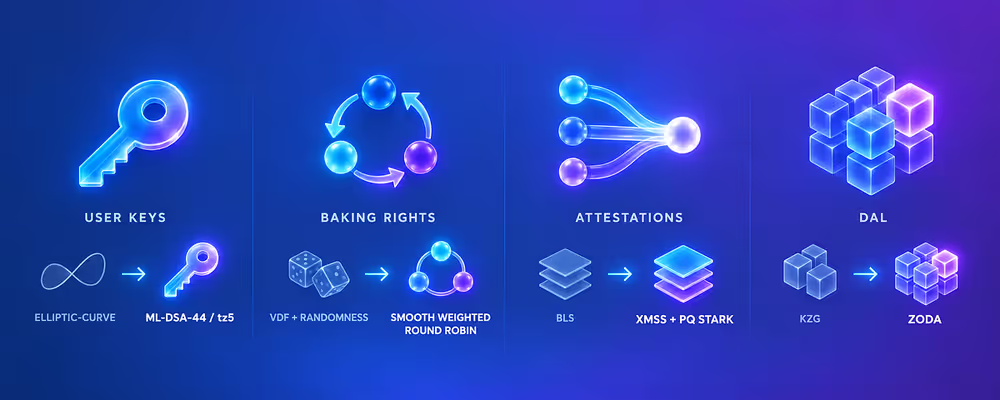
Alongside tz5 accounts, which allow user transactions to be authorized with ML-DSA-44 instead of the elliptic-curve signatures used today, three other parts of the protocol required changes
For baking rights, Quantumnet removes the Verifiable Delay Function and the need for protocol randomness, replacing the existing lottery with Smooth Weighted Round Robin. This distributes baking rights fairly according to each baker’s weight.
Consensus attestations are handled differently as well. The BLS signatures used on Tezos mainnet allow many attestations to be combined so they consume less block space. Quantumnet replaces them with hash-based XMSS signatures and a post-quantum STARK aggregation system developed by the LeanEthereum project.
Lastly, the DAL replaces its current KZG commitments and proofs with ZODA. Based on two-dimensional tensor codes, ZODA offers a potential path to post-quantum data availability without materially increasing the amount of information nodes need to exchange.
This first iteration also leaves out two other Michelson features. Sapling, which allows confidential transactions but relies on quantum-vulnerable cryptography, and timelock puzzles. It’s worth noting that when it comes to post-quantum privacy, TzEL has already been exploring how confidential, post-quantum transactions can be supported at the application level.
An engineering playground in the open #
Quantumnet has been built as an experimental testnet, with the current focus placed on integrating and evaluating the core components together. It is not intended for production use at this stage, and its limited UX reflects that technical focus. Exact hardware requirements are still being evaluated, but current expectations point to something above the lightest Tezos setups while remaining within the range of readily available consumer hardware.
Later iterations can extend that foundation with further security analysis, performance improvements, additional functionality, and better tooling. For now, the environment remains mainly intended for engineers, bakers, and technical contributors working on the protocol.
With that said, Quantumnet’s development will continue in the open, and the public network dashboard gives the wider community a live view of network activity and access to the available technical resources. So follow along as Quantumnet is tested, refined, and expanded through the iterations ahead.
Built for this kind of change #
Preparing Tezos for the post-quantum era will require changes at some of the deepest levels of the protocol, and Tezos already has a mechanism for making changes at that scale. Its on-chain governance has carried the network through 21 protocol amendments, providing an established route for new technology to be proposed, reviewed, voted on, and adopted.
That capacity was part of the project’s design from the beginning. Back in 2014, the Tezos position paper anticipated having “new cryptographic primitives included in the scripting language as the need develops.” Twelve years later, post-quantum cryptography is exactly the kind of long-term challenge that ability to evolve was designed to address.
The combination of a working experimental network and a proven amendment process leaves Tezos ideally positioned to adapt to the post-quantum reality. As the components being tested through Quantumnet mature, they can be strengthened and eventually brought forward as protocol amendment proposals. Tezos’ transition to the post-quantum era has begun.