Introducing Tezos X Previewnet
The first public testnet where Michelson and EVM interact through a shared ledger
6 minute read
The Tezos X Previewnet is now live, giving builders their first public environment where the EVM and Michelson interfaces come together in a way that hasn’t been available before.
This testnet offers the first opportunity to experiment with applications that can interact across both environments as part of the same flow.
With that now available, developers can start deploying, testing, and seeing what this new model actually makes possible.
Let’s take a closer look at what’s being introduced here, why it matters, and how you can start experimenting with it.
One System, Not a Set of Workarounds #
If you look at how most ecosystems are evolving, they tend to solve problems by adding more pieces.
Different environments, different layers, different chains, each doing its own thing. It works, but it also creates fragmentation. Assets live in one place, applications in another, and moving between them becomes part of the experience, often adding extra complexity, and in many cases, additional risk. Tezos X takes a different route.
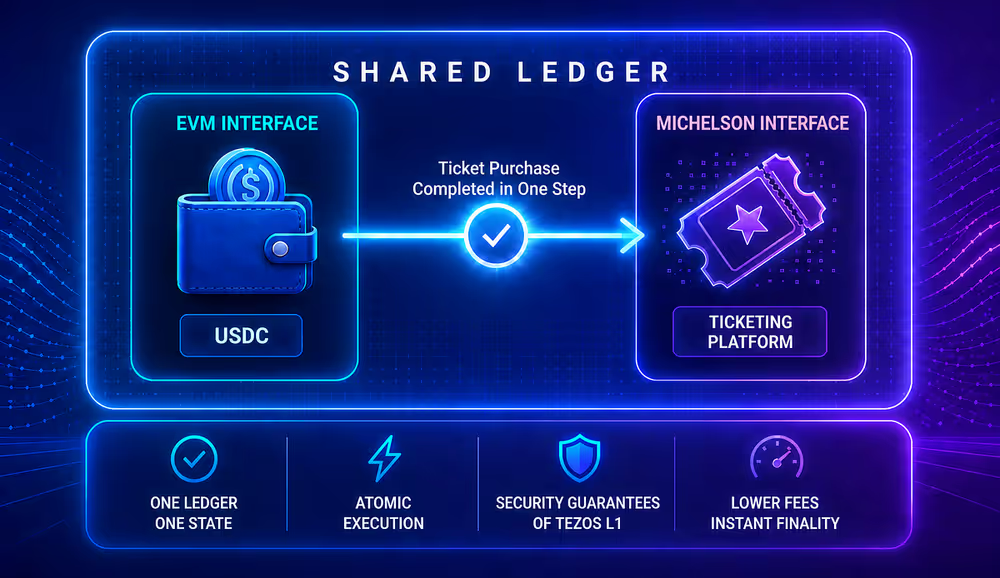
Tezos X is designed to reduce that friction by bringing those environments closer together from the start. Within Tezos X, a single shared ledger can be addressed through both the EVM and Michelson interfaces. That design enables native atomic composability.
Native atomic composability is what allows contracts across different environments to interact natively within a single transaction so that either all actions succeed or none do, without requiring intermediary steps like bridging or wrapping assets.
For example, imagine a ticketing platform built with Michelson, where tickets are priced in tez. A buyer comes in holding USDC in a MetaMask wallet on the EVM side. Normally, that means extra steps, swapping, bridging, wrapping, and moving assets across boundaries before anything can actually happen.
Here, those boundaries don’t exist within the system. The EVM user can interact directly with the Michelson contract, and the payment and the purchase can happen together, in a single transaction, executed atomically. All-or-nothing. No bridging, no wrapping, no loose ends.
One action, one result. That’s where things start to get interesting when you’re building.
What This Actually Changes for Builders #
Up until now, building usually meant committing to one environment. You pick your stack, your tools, your ecosystem, and everything follows from that.
With Tezos X, that trade-off starts to disappear.
If you’re already building with Solidity, you can keep doing exactly that. Same tooling, same workflows, same mental model. But now, you also have access to the Michelson side when it actually makes sense to use it. At the same time, if you’re building with Michelson, you’re no longer operating in a more isolated environment. You can tap directly into EVM-based users, assets, and liquidity without relying on external bridges or separate deployments.
That opens up a different kind of design space.
Some parts of your app can stay EVM-shaped, flexible, familiar, and easy to work with. But for parts where guarantees really matter, like how assets are handled or how certain rules are enforced, you can lean on the Michelson side.
Michelson contracts can be formally verified, meaning their behavior can be mathematically proven to match what they’re supposed to do. While this is something that can be done with EVM contracts too, it’s generally much easier to do in Michelson, as it was built from the start with formal verification in mind and you can even prove properties that are significantly harder to establish in EVM-based systems.
You don’t need to go deep into the theory to see the value, it simply gives you stronger guarantees where it counts. And with AI-assisted tooling putting formal methods within reach of almost any builder, it is becoming far easier to make use of those guarantees in practice. In an industry that keeps getting reminded how expensive smart contract failures can be, those guarantees are becoming much harder to overlook.
So instead of forcing everything into one model, you can start designing applications where both environments work together within the same transaction flow.
What Comes Next #
Once you start thinking about it this way, the next step is seeing how it holds up.
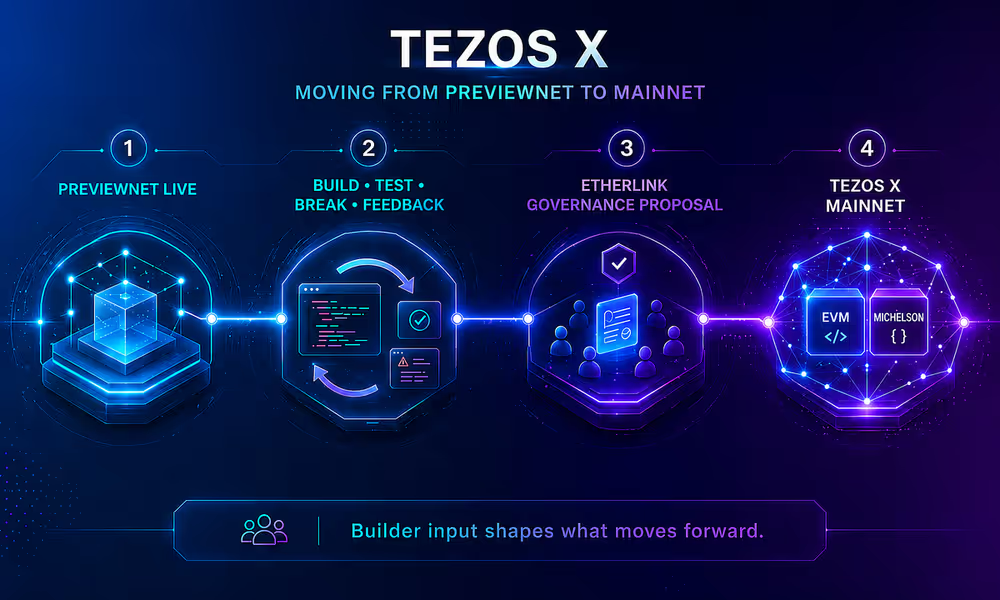
This phase is about seeing how these interactions behave in real conditions, what feels intuitive, what breaks, and what needs to change before anything moves further. It’s where assumptions meet actual usage, and where things become clearer once people start building with it. How builders use it, and where it breaks, will shape what moves forward to mainnet.
And that next step isn’t far off. Following this phase, an Etherlink governance proposal is expected around June 2026. If approved by bakers, Tezos X moves to mainnet with both the EVM interface and the Michelson interface live and fully composable from day one.
If you want to get a broader picture of how all of this fits together, the Tezos X roadmap update goes into more detail on the direction of the project and what’s coming next.
Getting Started #
At this point, the most useful thing isn’t another explanation, it’s actually using it. The testnet is live, the environment is there, and this is where builders come in.
Try things out, deploy something small, and see how it behaves. Push it a bit, break a few assumptions, and get a feel for how these interactions work when you’re actually building with them. And if something doesn’t work the way you expect, you can share feedback or ask questions in the dedicated Tezos X channel in the Tezos Discord.
If you want to get started, you can find everything you need here: