Metals, Meet Modern Rails
Rethinking how metals markets are accessed, from uranium to everything else
5 minute read
There are markets that move fast, and then there are markets that… never really changed. Metals fall into the second category.
We’re talking about assets that sit at the core of everything, energy, infrastructure, and manufacturing, yet the way they’re traded still reflects a much older system. In practice, it’s slower, more restricted, and less transparent than you’d assume. It works, but it hasn’t really moved forward with everything else.
There’s now an attempt to rethink that structure. Not by changing the metals themselves, but by rebuilding the infrastructure around them, how they’re accessed, how they’re traded, and how ownership is represented.
From Uranium to Something Broader #

Over the past year, uranium.io has come up more than once.
Not as a one-off experiment, but as one of the clearer examples of what this model can actually look like when applied to a real market.
Uranium isn’t exactly easy to deal with. It’s regulated, restricted, and for the most part sits behind institutional walls. Getting exposure has always been limited, not because there’s no demand, but because the infrastructure around it was never built for broad participation.
What uranium.io showed is that this can be approached differently. That you can open up access, keep a real connection to the underlying physical asset, and still make the whole thing usable without going through the usual layers.
So the obvious question becomes: what happens if you try to apply that same approach beyond uranium?
That’s where metals.io comes in.
What metals.io Actually Is #
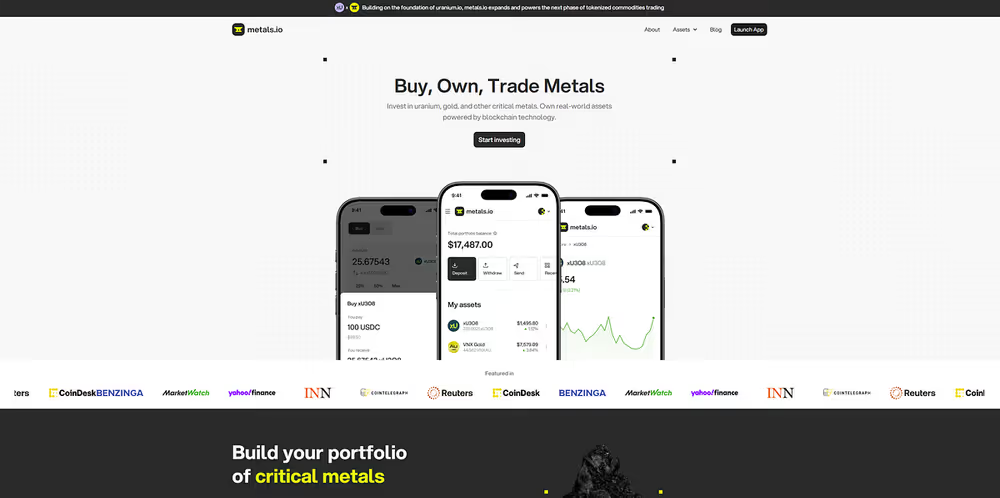
Metals.io takes the same approach we saw with uranium and applies it across a wider set of metals.
Instead of dealing with each market separately, everything sits within a single system. You’ve got access to gold, uranium, and a group of more niche but important materials, all through the same environment.
The experience itself is pretty straightforward. You’re not dealing with large minimums or waiting around for settlement. Access is continuous, ownership can be fractional, and transactions settle onchain rather than over days.
One detail worth noting is that not everything is structured the same way. Gold and uranium are available individually, while the newer additions come as a basket.
What matters more is how the exposure is structured. This isn’t about tracking prices through derivatives or indirect proxies. The model is built around real, physically backed assets, with systems in place to verify that backing, while the infrastructure handles custody, compliance, and pricing in the background.
From the outside, it feels simple. But that simplicity is coming from a system that’s doing a lot of the heavy lifting underneath.
The New Additions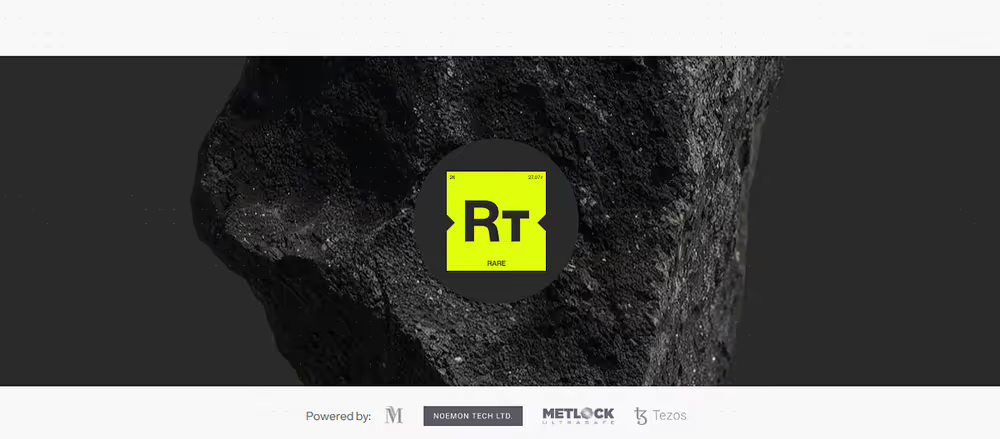 #
#
The expansion itself is one part of it. The mix of metals is the other.
I’ll be honest, I hadn’t even heard of most of these before.
Hafnium, rhenium, indium, neodymium, praseodymium. I can barely pronounce half of them, and I’d guess most people are in the same position. These aren’t the kind of metals that come up unless you’re already deep into specific industries.
But once you look into them a bit, you start to see where they fit. They show up in semiconductors, EVs, advanced manufacturing, and defense. Not in a visible way, but somewhere in the background of a lot of the systems we rely on, and that comes with real, ongoing demand.
And that’s probably what makes them interesting here.
Not because they’re new, but because they’ve always felt out of reach. You wouldn’t really know where to start, or how to get direct exposure to them in the first place.
Gold sits on the other end. It’s already accessible and widely understood, so it’s not really solving the same problem here. But it makes sense to have it alongside everything else. If you’re looking at metals, you’re probably looking at gold too, and it shouldn’t mean going somewhere else for it.
So it’s not just about adding more metals. It’s about bringing very different types of markets under the same framework, some that were hard to access, and others that were already accessible but not exactly efficient.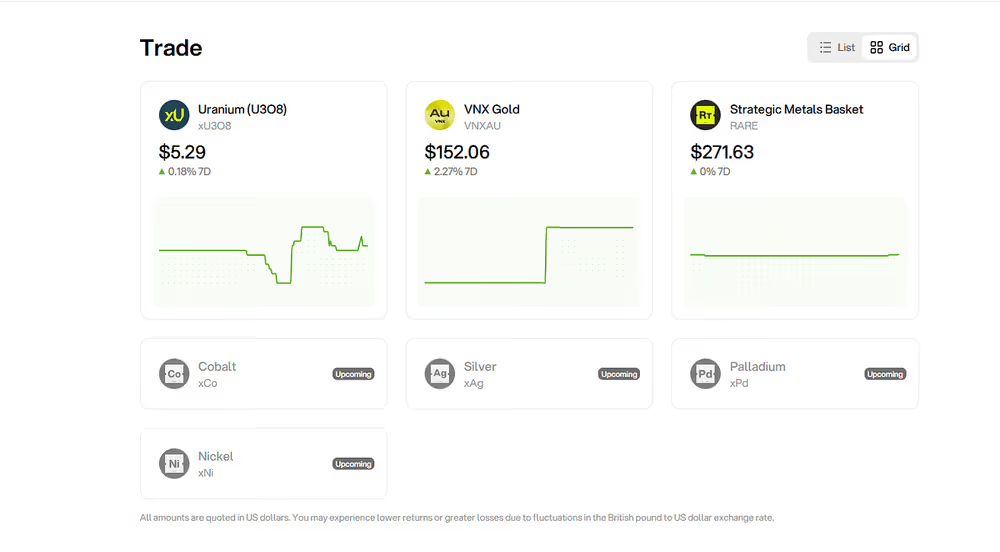
And once that happens, this is where things actually start to change, not in the metals themselves, but in how you get to them.
Access becomes more direct, settlement becomes instant, and pricing starts to become more visible. That might not sound like much, but in markets that have historically been slow, opaque, and restricted, it adds up quickly.
Some of these markets don’t even have clean price discovery today. Prices can depend on who you’re dealing with, or how the trade is structured. Bringing that activity onchain doesn’t solve everything, but it does start to standardize and expose it.
Even from the current interface, it’s clear more metals are on the way, silver, palladium, nickel, and cobalt. If that continues, this starts to look less like a single product and more like a growing layer for accessing the entire metals market, for both institutions and retail users.
Not just in making a few assets easier to reach, but in gradually rebuilding how these markets operate, moving from closed systems to something more open.
It’s still early, but it’s a lot easier to understand once you actually see it.