TezCon Exists Because We Said It Would
A weekend in Seattle with the people who gave an idea a room, a date, and a reason to return.
14 minute read
I didn’t notice the birds at Harry Reid. They were there in the desert morning, making themselves heard around the airport. I heard them. I simply didn’t register them until Seattle seemed quiet.
By the time anybody reached the room, the trip had already been happening for days. There are tickets, bags, borrowed cars, places to sleep, family schedules, equipment decisions, private negotiations, and the small financial calculations required to turn a public event measured in hours into several days of actual life. People came one or two thousand miles for this one. The distance looks ridiculous if you reduce the weekend to a schedule.
TezCon has always carried a little of that ridiculousness. It almost feels like it exists because we said it would, then kept doing the work required to stop the sentence from becoming a lie.
I still carry the larger picture. The Seattle Convention Center full of thousands of people jumping for technology, art, music, and culture. Screens. Sound. Light. Enough bodies in one place to make the floor feel nervous. I’ve never stopped wanting that.
This year wasn’t that. This year was a dining room table, an art loft, a house full of people on Sunday, and a long drive back to the airport. People crossed the country anyway.
Seattle met us with blue sky, green trees, overgrown greenbelts between neighborhoods, narrow roads, horns, traffic, and a man asleep on a pile of trash.
The strange part was the birds. I expected them everywhere and heard almost nothing until we reached the deeper greenbelts, where branches, yard waste, beavers, and whatever agreements existed between them had formed an improvised habitat. Then the birds returned with urgent business, mostly screaming at other birds of the same species to mate immediately. The desert had been louder.
Seattle was still recognizable, but memory had cleaned it up. Memory is good at preserving the trees and rain and neighborhoods while quietly removing the traffic, the territorial glances, the piles of garbage, and the way a single closed stretch of freeway can reorganize an entire day.
I was staying with my parents outside the city, moving through their house as their son while carrying my own years as a parent with me. Meals happened quickly. People borrowed space from one another. Bags opened and closed. Somebody always needed to know where somebody else had put something.
The I-5 corridor between downtown and the north side was closed for repairs. A drive that should have been easy became an hour of traffic and a private argument with the version of myself who could have prevented all of it by leaving earlier. Phoenix usually gives you another road. Seattle is a giant hill in the middle of the water, and there are only so many ways around it.
Friday #
Friday took us to Marc Fendel’s house in quiet West Seattle for the Artz Friday livestream. Marc had a huge dining table, which turned out to be exactly the right size for an event that hadn’t yet decided whether it was a broadcast, a reunion, a technical emergency, or an elaborate attempt to make me laugh hard enough to lose control of my own face.
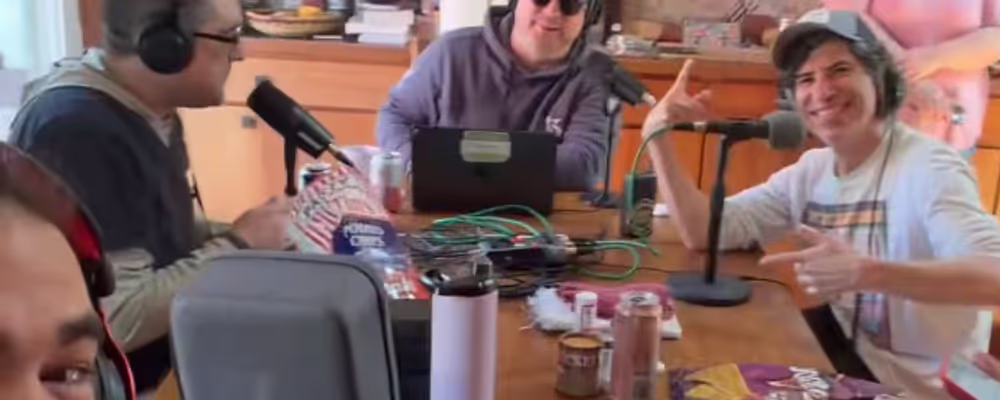
FlexasaurusRex sat to my left. Marc sat across from me. Yoeshi was the host and the primary leader of the whole thing, despite waking up sick and being unable to keep water down. He kept going well past the point when most people would have made the sensible decision to disappear under a blanket and let everyone else sort it out.
I was busy counting failure points. Mutes. Double broadcasts. Missing hosts. Open microphones. Random buttons. The possibility that one wrong click could send the whole thing sideways while I sat there pretending to be a person who had definitely done this before.
I’m a nervous laugher. It starts low in my stomach, climbs into my chest, and eventually becomes a rolling snort that announces to everyone nearby that my nervous system has abandoned professional discretion.
Then Flex fat-fingered the soundboard. A loud, jazzy trumpet sting ripped through the broadcast, cheerful enough to sell toothpaste and aggressive enough to make me think the stream had been hacked. Bah-dah bump bump bah. The little rise at the end left a space that practically demanded a breathy, unnecessary “yeah.”
At this point the whole table froze. My wife, listening on delay, looked up at me in shock. From where she sat, we had all simply stopped and stared at one another, and the delay gave her no idea why.
The first hit was an accident. Flex had found the button with his hand before any of us had found the joke. Once it became clear there was something worth pushing, Marc jumped on it. He pressed the soundboard again and pointed at Flex when the music created the unmistakable need for an announcement. Flex looked at the table and said, “TezCon 26, let’s get down to the downtown.”
That should have been the end of it. Marc pressed another button. Flex accepted the assignment.
A new slogan appeared around whatever guest, artist, or conversation happened to be in front of us. “TezCon 26, you can’t tell Para what to do.” Another sax run. Another plug. Another few seconds of everyone trying to understand how we had arrived at this exact point in our lives.
By the end, Yoeshi worried we had overdone it and damaged the show. The rest of us had the stunned look of people who had found a lever marked DO NOT PULL and discovered that pulling it made jazz happen.
That soundboard became the sound of TezCon 26. Nobody stopped the broadcast to decide whether the joke belonged.
It already did.
Saturday #
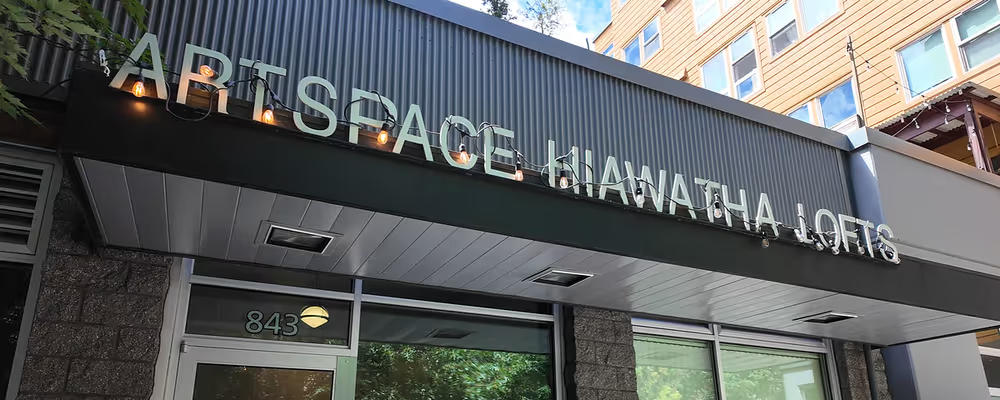
Saturday began with traffic. The freeway closure stretched the drive into another hour of watching the clock and conducting a useless internal trial against myself. Near Artspace Hiawatha Lofts, the neighborhood was already busy with its own programming. Pairs of people walked toward coffee. Bicycles and accessories gathered around the corner shop. Flowerboxes had been tended. There were few cigarette butts and little visible garbage.
Up the street, a car made several attempts to parallel park. It pulled forward, backed in, stopped. Pulled out, tried again, stopped. Eventually both doors opened and two people stepped out. The driver put both hands on their hips, stared at the curb, and said “hmmm” several times while an entire audience stood there watching. You think telenovela is good.
Inside Hiawatha, the room was large, open, and useful. Several pianos. Tables. Chairs. A kitchen. A bathroom. Walls for art. Floor for people. A roll door that could open the whole place toward the street. There wasn’t a stage, just a performance area.
Food gathered in the center. Juniper’s Sushi Art Shop appeared near the performance area. A local artist and her mother set up nearby. NFT artwork reached the walls. An interactive musical display waited for hands. Tables became less like booths than little windows into whoever stood behind them.
We were missing some of the normal conference equipment. Tablecloths. Runners. Banners. Handouts. Branded installations arranged by people who had spent several meetings deciding where the logo should go. What we had was people carrying things through the door: art, food, music, conversation, friendship, and whatever B was about to do in a crocheted corn mask.
Ryan Tanaka began at the grand piano. Books, paper, a phone, and a ping-pong ball entered the instrument. The piano clicked, buzzed, shifted, and moved under the pressure of being asked for sounds it had no reason to produce. Ryan wasn’t giving us a clean prepared-piano demonstration. He was testing the thing with whatever happened to be available and listening to what came back. I couldn’t decide whether to be horrified or impressed.
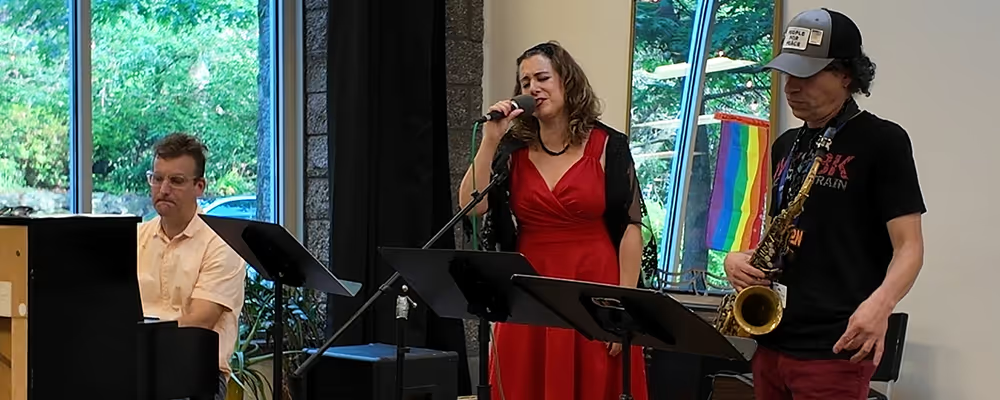
Then Red Alark, Alex Guilbert, and Marc Fendel began playing. I watched people gather near the performance area, then drift back toward conversation, food, movement, and the other work hanging around them.
Erika followed with Voices of Iran. The schedule listed the presentation and panel separately, but the presentation moved straight into the panel and the conversation kept going. The project had to move through bureaucracy, sanctions, and financial barriers before those voices could reach the table in Seattle. Politics makes it easy to compress Iranian people into the actions of a government. Erika brought the zine and the voices inside it into the room without flattening them into the politics surrounding them.
Hello Carmello DJed. Yoeshi performed after powering through Friday. By the time B began making electronic music inside a crocheted corn mask, I had stopped trying to decide what category the day belonged in. The mask looked exactly as unreasonable as that sentence suggests, and it was glorious.
The room stayed full between acts. Ryan’s altered piano remained part of the day even after he left the bench. Food disappeared and reappeared. People drifted toward art, toward music, toward someone they had only known as a handle, then back toward whoever was making the next sound.
I kept meeting people I already knew, then realizing how little of them I had actually met. Online, most people arrive in pieces: a voice in a Space, a post, a joke, a sarcastic reply, a profile picture, a piece of art, an argument remembered longer than whatever started it, or a tired answer that becomes evidence of permanent character. Every piece can be true and still shrink the person once you start treating it as complete.
Red is familiar online. In a room, familiarity acquires gait, timing, eye contact, hugs, consolation, family, and the precise split second in which sarcasm becomes something everyone nearby can either understand correctly or run from. You see someone place a hand on another person’s shoulder. You see who stays after the formal part ends. You hear the laugh that never survives the microphone. You notice fatigue, stubbornness, awkwardness, generosity, and the extra few seconds a person takes before answering something that would have received an immediate reply online.
Ryan has said the first TezCon helped inspire his move to Seattle. Red announced her own move before TezCon 26, with Ryan, Marc, and TezCon among the influences. Neither had moved for TezCon alone. In that room, people who had first arrived in pieces were standing near one another. The program put a date on the calendar. The people made the distance make sense.
By the scheduled open-mic and jam period, chairs were moving. Equipment came down. People carried objects back toward cars and corners and whatever temporary home they had occupied for the day. The schedule had promised one more act. The room had reached the part where somebody needed to deal with the cables.
The first TezCon had needed something more basic: proof that the gathering could exist at all. Before it, TezCon was something people said should happen. Afterward, there were shared memories, inside jokes, faces attached to handles, and a reason to do it again.
The second came with more itinerary, more before and after, more effort, enough that the main event could begin with people already tired from everything packed around it.
By the third, the day didn’t have to survive exactly as written. The soundboard kept going. The piano became a toolbox. The open mic became cleanup. When something changed, people accepted it, added something, and kept moving.
I still want the convention center. I still want the noise and the impossible picture made physical. Parenthood has made me suspicious of the futures we design for things we love. The picture can become so vivid that reality begins to look disappointing simply because it refuses to pose correctly. Caring about a future doesn’t give me control over its exact shape. It doesn’t excuse me from looking directly at what is already there.
I’m not trying to find the diamond in the rough. That’s us already.
Sunday #
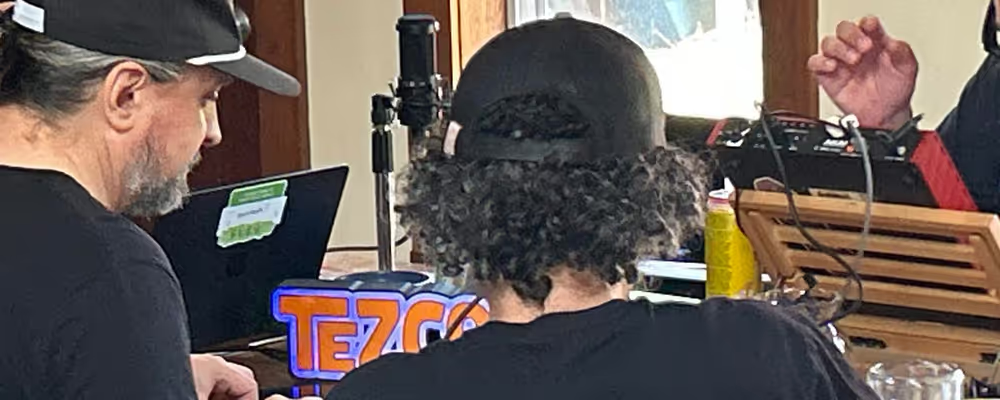
By Sunday, the same people were back at Marc’s house before the weekend had settled into the past. People moved between the living room, kitchen, and dining room. Juniper sketched nearby. Music-production equipment covered the kitchen table. Food, tired bodies, unfinished conversations, and new plans occupied the same space without anybody needing to organize them into a program. People talked about what worked, what didn’t, what they missed, who they had failed to spend enough time with, and what the next version could include. The conversation moved in fragments because people were crossing rooms, getting food, stopping to greet someone, returning to a thought twenty minutes later.
People stopped talking around the work and said it to the person who had done it: I see what you do. I appreciate it.
I caught conversations I had missed on Saturday. I gave B another hug. Then I remembered the chips.
The year before, somebody had mentioned the handmade chips sold at El Super, a regional supermarket chain I recognized from back home. They’re greasy, delicious, and exactly the sort of food that makes a paper bag translucent enough to become a warning label. B asked me to bring some if I remembered. I didn’t. I still owe you chips from El Super.
Next year’s TezCon already has a date: June 12 in Georgetown, alongside the neighborhood’s monthly Art Attack. Nobody in Marc’s house could know what that setting will produce yet, but another date exists anyway.
When the time came to leave for the airport, everyone else was already loading up in two different cars. I stayed inside my parents’ house for one last sweep. At first that meant what it usually means. Check for a dirty dish. Pick up any garbage. Look for the leftover evidence of a meal eaten too quickly and several days compressed into bags, cars, departure times, and somebody outside wondering what was taking so long.
Then I kept walking.
The house was quiet because everyone else was waiting in the driveway. I moved from room to room and realized I didn’t know when it had stopped being my house. Nobody had announced it. There hadn’t been a clean moment when I became a visitor. My parents were still my parents. I was still their son. But the rooms belonged to their routines now. Things were where they had chosen to put them. Their life continued there while I was somewhere else building one of my own.
For the first time, I walked through my parents’ house as though I were a guest in their life. Guest wasn’t quite right either. I may never be a guest in the ordinary sense. I’ll always be their son. Some part of me will probably always walk through that door with the old assumption that I belong there. But belonging doesn’t require the house to remain mine in the same unquestioned way.
My eyes began to well before I had finished deciding why. All week, I’d been good at noticing what was late, missing, misplaced, or changing too fast. A route somebody should’ve checked. A delay. A soundboard button pressed without warning. Those gave me something smaller to argue with.
I was less reliable at saying what I loved before the cars were loaded. There’s always supposed to be another room, another weekend, another visit, another chance to say the thing correctly when nobody is tired and no one is waiting outside.
My dad was waiting outside.
I took one last look through a house that was no longer mine in the way I had always assumed it was, and still knew I wasn’t leaving it as a stranger. I love you. I appreciate you. I see what you do.