Understanding Tezos' Proposed Liquid Staking Token (sTEZ)
What it is, why it's being proposed, and how the canonical LST could fit into the Tezos ecosystem
8 minute read

On Tezos, participation has always been fairly straightforward. For years, delegation has allowed anyone to earn rewards while keeping their tez liquid and fully accessible at all times. With the ParisB upgrade, staking was introduced as a more active option, where users can lock their tez to earn higher rewards while contributing more directly to network security.
Between delegation and staking, it feels like the bases are covered. One offers flexibility and liquidity, the other offers higher rewards in exchange for locking funds. Both serve clear purposes, and so far, they’ve been working well.
But now, a new approach is being proposed. A couple of months ago, a concept called the “Enshrined Liquid Staking” was introduced on Tezos Agora as another potential option around staking. So naturally, a few questions come up.
What exactly is it? How would it work? And maybe most importantly, do we even need it? Here’s how I’ve come to understand it.
The Limits of Delegation and Staking #

What Tezos offers today works well within its own environment. Delegation and staking both do what they’re supposed to do, and for a long time, that’s been enough. But things start to shift once you move beyond that.
If you decide to take your tez into DeFi, or move it to environments like Etherlink (upcoming Tezos X), that connection breaks. Your tez is no longer part of the staking flow. It’s active elsewhere, but at the same time, it’s not earning staking rewards, and it’s no longer contributing to securing the network.
This isn’t unique to Tezos. Across other ecosystems, similar patterns have led to the rise of third-party liquid staking solutions, tokens that represent staked assets while still being usable elsewhere. Things like stETH on Ethereum follow this idea, allowing users to stay exposed to staking while still participating in DeFi. Tezos has already seen early versions of this approach as well, with solutions like stXTZ aiming to bridge that gap.
But as useful as these solutions are, they also introduce a new set of considerations.
Adding extra layers to staking #

Once you introduce a third-party liquid version of staked assets, the way staking works starts to shift.
Instead of interacting directly with the protocol, users rely on an additional layer that handles staking on their behalf. Depending on the design, that layer can involve smart contracts, operators, or specific coordination mechanisms that sit between the user and the network. That changes a few things.
At the network level, stake is what secures Tezos and what gives participants influence in governance. If more and more of that stake is routed through the same liquid staking systems, it can start to concentrate in fewer places. Not because it’s designed that way, but because liquidity naturally pulls users toward the same solution. Over time, that concentration can matter. It can influence how stake is distributed across bakers, and potentially who ends up having more say in the network.
There’s also the question of trust. Even when systems are transparent, users are no longer interacting only with the protocol, they are relying on how that system is built and maintained. Smart contracts reduce the need for intermediaries, but they don’t remove risk entirely. Bugs, upgrades, or admin keys can all affect how that system behaves over time.
None of this makes liquid staking tokens a bad approach. It solves a real need, and it’s already widely used across the industry. But it does introduce an extra layer between users and the protocol, and that layer comes with tradeoffs that need to be understood.
A Different Approach: Protocol-Level Liquid Staking #
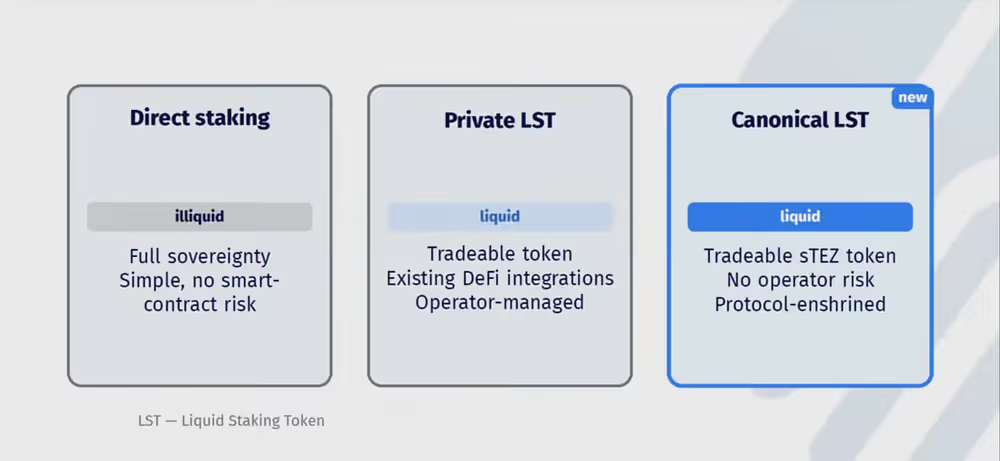 source: Mathias Bourgoin’s presentation at TezDev
So what if that extra layer didn’t sit outside the protocol, but inside it? That’s the idea behind the proposed canonical LST on Tezos.
Instead of relying on external systems to manage staking, the mechanism is built directly into the protocol itself. There’s no separate operator, no admin keys, and no third-party contract managing the process. From a user perspective, the interaction stays familiar, but the logic behind it is handled directly by the protocol. The rules are defined at that level and follow the same governance process as everything else on Tezos.
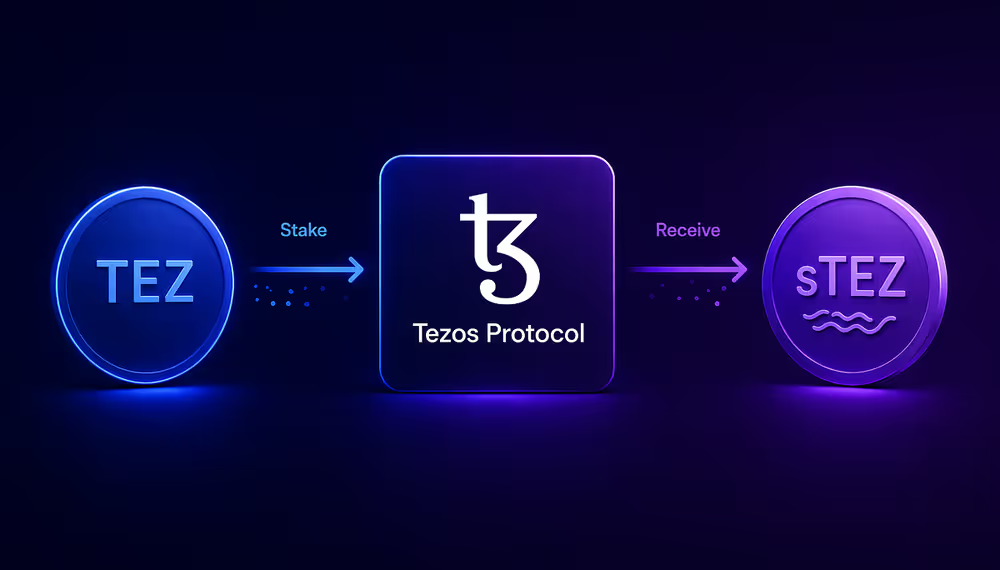
From a user perspective, the flow is straightforward. You deposit tez and receive a liquid token in return (sTEZ). That token represents your share of the underlying stake and can be held, transferred, or used elsewhere, just like any other standard token.
At the same time, this doesn’t mean the system is “hands-off.” There are still mechanisms in place to manage how stake is distributed, how risk is handled, and how the system avoids the kind of concentration we discussed earlier. The difference is that all of this is defined at the protocol level, rather than being handled by an external layer.
So how does that actually work in practice?
How It’s Designed to Work #
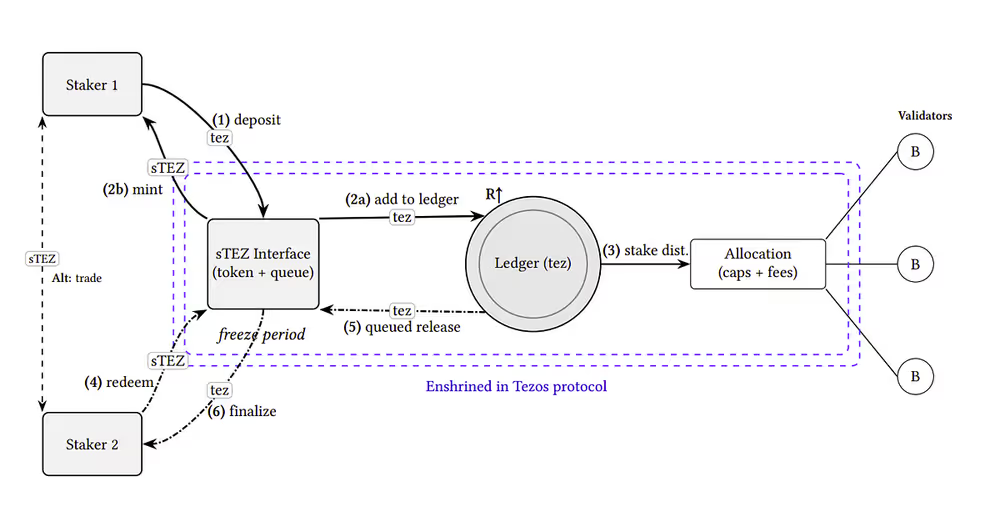 Source: Canonical LST Whitepaper
At a high level, the idea is simple. You deposit tez into the system and receive a liquid token in return, commonly referred to as sTEZ. That token represents your share of the underlying stake and can be held, transferred, or used elsewhere, just like any other token. From there, the system follows an accrual model.
Instead of distributing rewards as separate payouts, rewards are reflected in the value of the token itself over time. In simple terms, one sTEZ gradually becomes worth more tez as rewards accumulate. The same applies in the opposite direction, where if slashing occurs, that value can decrease as well. When you want to exit, you redeem your sTEZ. The system initiates an unbonding process, similar to unstaking today, and once that period is complete, you receive your tez back.
Behind the scenes, the protocol takes care of how stake is distributed across bakers. But unlike traditional delegation or staking, bakers actively choose to participate in this system. They register and define specific parameters, such as how much of their capacity they allocate to this form of staking and the fee applied to it.
The main difference is that users are no longer the ones deciding where their stake goes. Instead, the protocol handles the allocation itself, spreading it across participating bakers while respecting those parameters and keeping things within limits designed to avoid concentration and maintain a more balanced distribution.
One important detail is that this stake does not carry governance rights. Even though it contributes to securing the network, it doesn’t participate in voting. That separation is intentional, as it avoids concentrating governance power through a liquid token that could otherwise scale quickly across the ecosystem.
So where does this leave us? This isn’t meant to replace delegation or staking. Those are still the core ways people participate in Tezos today. This just adds another option, one that brings liquid staking into the protocol itself, without relying on external solutions and the tradeoffs that come with them.
If it works as intended, it could lead to more tez being staked while still remaining usable elsewhere. That would probably increase the overall staking ratio over time, which in turn can reduce issuance. It might also make it easier for newer bakers to get external stake, which feels really helpful when you are starting out. Keep in mind, this is just how I’ve come to understand things based on what’s been shared so far.
The canonical LST is part of the Ushuaia proposal. If it passes, it won’t be fully active right away. Instead, it would be introduced behind a feature flag, allowing it to be tested in controlled environments like testnets and refined over time. Activation would only come later, in the next (V) proposal, once the system has been evaluated in practice.
There are still parameters and details that need to be finalized, and these are already being discussed on Tezos Agora. If you’re interested in digging deeper, check out the TezDev presentation from Mathias Bourgoin, the whitepaper, and the discussion on Tezos Agora. And if you have an opinion on this, don’t just keep it to yourself, jump into the Agora thread and be part of the conversation.