What Happens to Tezos Layer 1 After Tezos X?
Exploring what Tezos X could mean for the future role of Layer 1.
8 minute read
There is a question that comes up every now and then in the Tezos community, and I’ve heard versions of it during our X Spaces as well. What actually happens to Tezos Layer 1 once Tezos X is fully here?
I have even noticed that there is still some confusion around the original Tezos X roadmap. Some people seem to be under the impression that everything currently living on L1 will eventually be moved into Tezos X. That makes sense, because this was actually part of the initial thinking around Tezos X, while the later decision to drop that idea didn’t get nearly as much attention.
So I thought it might be worth talking about what the current plan actually is, and more importantly, what I think could happen from here.
Before we go any further though, I should clarify that I’m not writing this because I know exactly what Tezos Layer 1 will look like five years from now. I don’t. What follows is mostly my own thinking based on the direction Tezos X is taking, the changes we’ve already seen along the way, and what I personally think is likely to happen once the whole experience is mature enough for people to actually use it as intended.
The Original Idea #
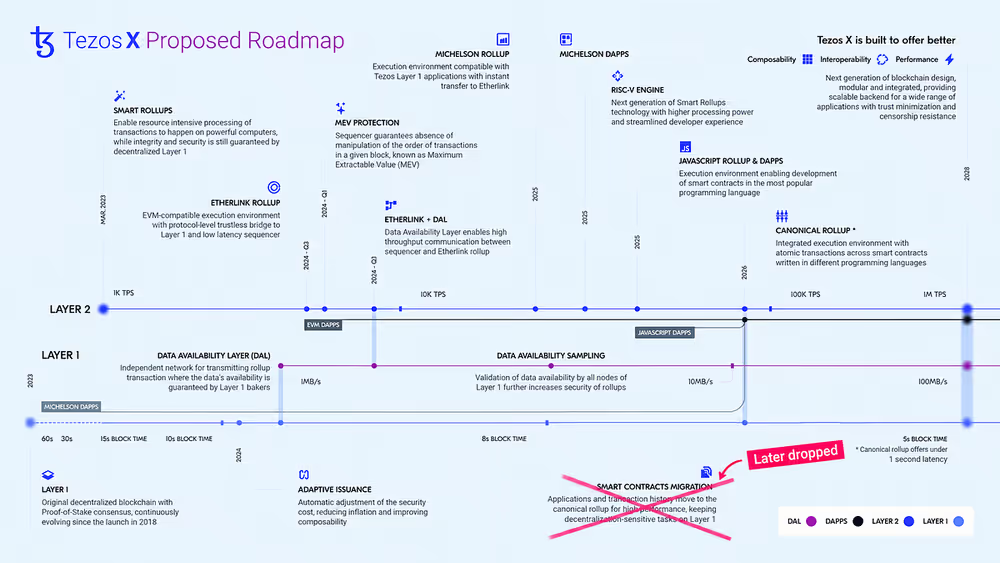
The initial proposed roadmap for Tezos X. The latest update of the roadmap can be found here.
When the first Tezos X proposed roadmap came out, one of the ideas was to eventually migrate the existing Layer 1 state into the new execution environment.
This wasn’t about asking every project on Tezos to pack its bags, rebuild its application on L2, and hope its users followed. The idea was much more seamless than that. The state itself would move, allowing applications and accounts that already existed on L1 to continue operating without developers having to make major changes themselves.
That would have left Layer 1 with a much more focused role, handling things such as consensus and settlement while most application activity happened in the new execution environment.
That idea was eventually dropped. Existing applications can stay exactly where they are, and there is no future point where everything currently running on L1 is automatically moved somewhere else. Developers can decide what makes sense for their own applications. Which, of course, creates another question.
If nothing has to leave Layer 1, then what actually changes?
What I Think Happens Instead #
My guess is that over time we may still end up heading in a similar direction, just without needing any big transition where everything changes at once.
Think about what Tezos X is supposed to offer when the whole thing is finished. Michelson and EVM applications will share the same environment. They will be able to interact through Native Atomic Composability. Liquidity can be shared across both sides. Performance should be considerably higher, and the wallets and tooling around all of this should eventually make using it feel much less complicated than using different networks does today.
At that point, I think it becomes pretty easy to imagine where most new applications will want to launch.
If I’m a developer starting something new and I can have all of those advantages while still building with Michelson if that is what I prefer, I’m probably going to choose Tezos X. Existing applications may eventually come to the same conclusion too, especially if that is where more users, liquidity, and other applications start to gather.
Obviously that doesn’t mean every application currently on L1 will eventually leave. Some may be perfectly happy where they are, and there might be applications where there simply isn’t enough reason to change anything.
But if most new development starts happening on Tezos X, and some existing projects decide to use it as well, then naturally the amount of application activity happening directly on Layer 1 should start decreasing.
There doesn’t really need to be an official moment where someone announces that L1 has changed its purpose. It could happen gradually, simply because the way people use Tezos changes.
What Does That Mean for L1? #
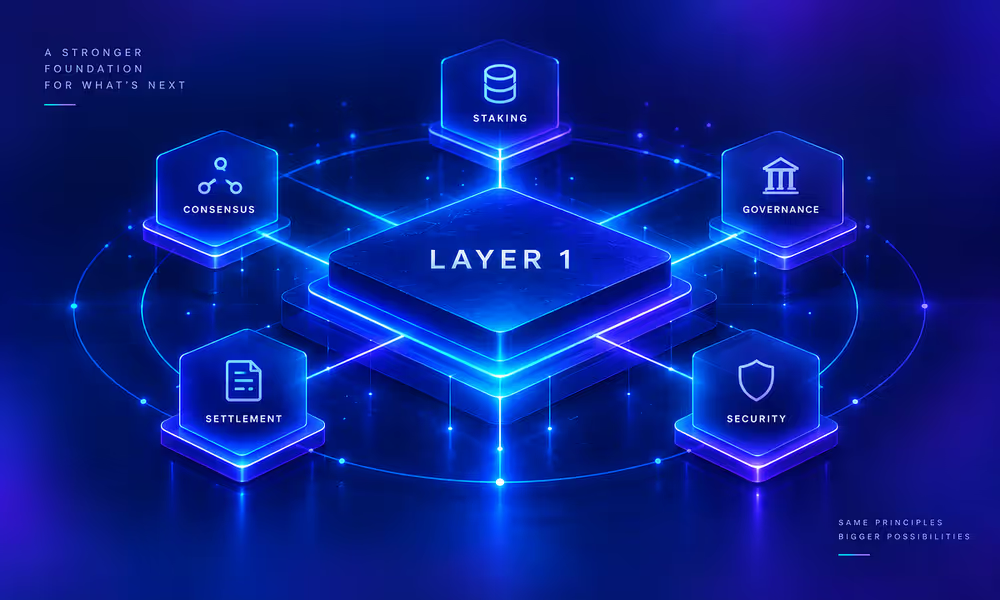
Layer 1 currently has a lot of responsibilities. It has to handle consensus, staking, governance, applications, smart contract execution, user transactions, and at the same time remain secure and accessible enough that running a baker doesn’t require some ridiculous machine sitting in a data center.
That means there are always trade-offs when trying to improve it. Performance matters because applications are running there. Block times matter. Smart contract throughput matters. Storage matters. Baker hardware requirements matter. Security matters. Decentralization matters.
But if more and more application execution starts happening through Tezos X, then some of those priorities begin to change.
There would be less reason for L1 itself to compete on how quickly it can execute a complicated smart contract if that contract can already run much faster somewhere above it. Instead, more attention could go toward the things Layer 1 will continue being responsible for regardless of where applications run, like consensus, staking, governance, settlement, finality, data availability, Smart Rollup security, and generally making the foundation of the network as strong as possible.
That could also give Tezos more freedom when making future protocol decisions. If squeezing every bit of application performance out of L1 becomes less important, you can start thinking more about efficiency, security, decentralization, and keeping hardware requirements low.
Personally, I think that sounds like a pretty reasonable evolution. L1 would still be doing a lot, and the most important jobs in the entire system. It would just be doing fewer things that can be better handled elsewhere.
“But I Like Using L1” #
I can already hear this one.
“So eventually I’m going to have to start using an L2? What if I don’t want to?”
I think part of the problem here is what most of us currently associate with the term L2. Today, moving from Tezos L1 to Etherlink feels different. Etherlink is an EVM environment, so you’re dealing with different wallets, different applications, bridges, and a user experience that naturally feels much closer to Ethereum than the Tezos experience many of us are used to.
If that is what you imagine when I say that more activity could eventually happen through Tezos X, I can understand why you might not be particularly excited about it. But that isn’t really where this is heading.
We already have the Michelson interface inside the same environment as EVM, and that changes the experience a lot. As the rest of the tooling catches up, someone who is comfortable using Tezos today should eventually feel pretty comfortable using Tezos X too.
Ideally, you shouldn’t be sitting there thinking about whether the application you just opened is running directly on L1 or somewhere above it. You open your wallet, use the application, make your transaction, and move on.
And if the experience feels familiar while also being faster and giving you access to more applications, more liquidity, and features that weren’t possible before, wouldn’t you want to use it? I know I would.
To me, that is actually a pretty important part of whether Tezos X works in the long run. The technology can be impressive, but if users constantly need to think about layers, bridges, environments, and where exactly their assets currently live, then we haven’t really reached the seamless experience we’ve been talking about. The goal should eventually be much simpler. You’re using Tezos.

So, what happens to L1? Probably nothing dramatic overnight. Your favorite L1 application is not going to suddenly disappear. Nobody is turning off Michelson on Layer 1. And there is no date when everyone has to wake up and start using Tezos differently.
If things move in the direction I expect, this will happen gradually. More new applications may choose Tezos X. Some existing ones may follow. Over time, less application activity may happen directly on L1, while Layer 1 becomes more focused on securing and coordinating everything above it. And even that direction is not set in stone.
One thing we have learned over the years is that plans evolve. The original Tezos X roadmap has already changed in meaningful ways, and I would be surprised if every detail we imagine today looks exactly the same a few years from now. And that is normal. That’s generally how development works. You build something, you learn from it, and sometimes a better path becomes obvious along the way.
For now, I think the most likely direction is fairly simple. Tezos X gradually becomes the place where more application activity happens, while Layer 1 becomes increasingly focused on securing, coordinating, and supporting everything built above it.
And if we eventually get to a point where most users don’t even think about that distinction anymore, I’d say we probably got it right.